
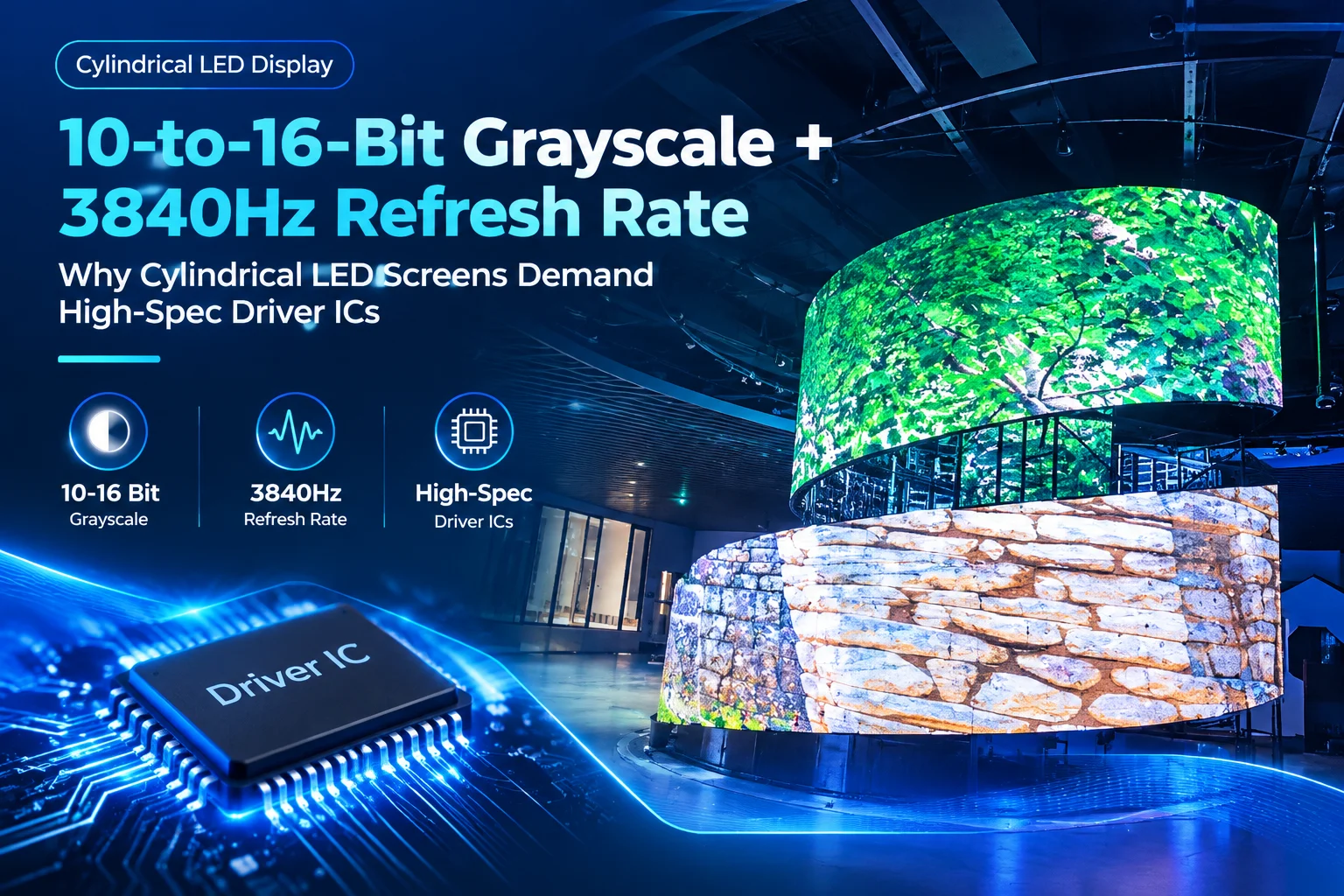
10-to-16-Bit Grayscale + 3840Hz Refresh Rate: Why Cylindrical LED Screens Demand High-Spec Driver ICs
When evaluating a cylindrical LED screen, system integrators often ask why curved displays need higher-spec driver ICs than standard flat LED video walls.
A flat LED display typically serves viewers from a primary viewing direction. However, a cylindrical LED screen wraps 360° around a structural column or central axis, creating continuous viewing angles and more complex optical conditions.
This curved geometry makes grayscale banding, brightness differences, and camera flicker more noticeable. To render curves smoothly and capture reliably, flexible LED modules often require 14–16-bit grayscale processing and refresh rates of at least 3,840 Hz, depending on the application.
Understanding these technical requirements helps buyers specify the right driver ICs for commercial cylindrical LED display projects.
1. Cylindrical LED Screen vs. Flat LED Display: Key Technical Differences
The main difference between flat and cylindrical LED displays lies in viewing geometry and how visual imperfections appear across the screen.
| Performance Metric | Standard Flat LED Display | High-Spec Cylindrical LED Screen |
|---|---|---|
| Viewing Angle | Primarily perpendicular viewing direction | Continuous 360° omnidirectional viewing |
| Light Distribution | Relatively uniform surface plane | Curved light distribution creates varying shadow gradients |
| Refresh Rate Target | 1,920 Hz for standard static viewing | ≥3,840 Hz for improved camera performance |
| Grayscale Processing | 10–12-bit processing | 14–16-bit processing for smoother low-brightness transitions |
| Module Seams | Flat module connections | Curved flexible module seams require finer low-brightness control |
| Brightness Uniformity | Calibration across a flat surface | Precise calibration across 360° viewing angles |
A cylindrical LED screen therefore requires more than flexible modules and a curved mounting structure. Driver IC performance also plays an important role in maintaining visual consistency across the entire display.
2. Why Does a Cylindrical LED Screen Need High-Spec Driver ICs?
Three technical factors explain why curved LED displays often require higher grayscale depth, refresh rates, and current-control precision.
2.1. 16-Bit Grayscale Processing Reduces Visible Seam Artifacts
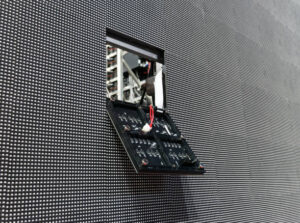
When flexible LED modules wrap around a small-radius pillar, mechanical tension and module alignment can create subtle differences along the edges.
These differences become more noticeable in dark video scenes or at low brightness. Displays with limited grayscale performance may render gradual shadow transitions unevenly, producing vertical contour lines or dark bands around module seams.
High grayscale processing helps reduce these artifacts.
- 10-bit grayscale: 1,024 levels per color channel.
- 12-bit grayscale: 4,096 levels per color channel.
- 14-bit grayscale: 16,384 levels per color channel.
- 16-bit grayscale: 65,536 levels per color channel.
A 16-bit grayscale system provides finer tonal steps, helping the display reproduce gradual dark-to-light transitions and minimize visible seam differences at low brightness.
For high-end indoor cylindrical LED screens, buyers should evaluate grayscale performance under actual operating brightness rather than relying only on the maximum bit-depth specification.
2.2. A Refresh Rate of ≥3,840 Hz Improves Camera Performance
Cylindrical LED screens often appear in retail spaces, hotel lobbies, exhibitions, and other environments where visitors capture photos and videos.
When cameras record an LED display, the camera shutter and the display’s LED driving cycle can interact. Depending on shutter speed, scan architecture, and other settings, this interaction may produce black scan lines, flicker, or moiré patterns.
A refresh rate of ≥3,840 Hz can improve camera performance compared with lower-refresh-rate systems, particularly those operating at 1,920 Hz or below.
However, refresh rate alone does not guarantee completely flicker-free footage. Camera shutter settings, scanning methods, PWM behavior, and driver IC design also affect the final result.
For cylindrical LED screen projects intended for promotional videos or broadcast capture, integrators should test the display with representative cameras and recording settings before finalizing the hardware specification.
2.3. Precise Current Control Supports 360° Brightness Uniformity
A cylindrical LED screen presents different surface angles to viewers positioned around its circumference. These viewing conditions can make small differences in LED output or calibration more apparent.
For premium indoor installations, the original engineering target is brightness uniformity of ≥95% across the curved display surface.
High-quality driver ICs help maintain consistent current output across LED pixels. Combined with module calibration and optical adjustment, this can reduce visible light and dark bands as the screen curves away from the viewer.
For commercial installations such as hotel lobbies, airports, and flagship retail stores, buyers should confirm the supplier’s brightness-uniformity measurement method and acceptance criteria.
The original specification identifies uniformity below 90% as a potential source of noticeable light and dark banding across the cylinder.
3. How to Select Driver IC Specifications for a Cylindrical LED Screen
The appropriate driver IC specification depends on the display’s installation environment, viewing conditions, and content requirements.
| Selection Parameter | Original Engineering Target | Main Purpose |
|---|---|---|
| Grayscale Processing | 14–16 bit | Smooth low-brightness gradients and reduce visible contouring |
| Refresh Rate | ≥3,840 Hz | Improve camera capture and reduce visible flicker risk |
| Brightness Uniformity | ≥95% | Maintain consistent brightness around the curved surface |
| Module Design | Flexible LED modules | Conform to the required cylindrical radius |
| Calibration | Pixel-level calibration | Reduce brightness differences across modules and seams |
| Camera Testing | Test with intended recording equipment | Verify real-world camera performance |
These values provide a starting point for specification discussions rather than a universal guarantee for every installation.
System integrators should evaluate driver ICs alongside pixel pitch, module radius, scanning architecture, operating brightness, and the content that the display will show.
4. Frequently Asked Questions About Cylindrical LED Screens
Q1. Why do black scan lines appear when recording a cylindrical LED screen?
Black scan lines can occur when the camera shutter interacts with the display’s refresh and scanning cycles. Curved viewing angles and differences in camera position may make recording artifacts more noticeable.
A refresh rate of ≥3,840 Hz can help reduce this risk, but camera shutter speed, scan design, and PWM behavior also influence the result. Testing with the intended camera setup is the most reliable way to confirm performance.
Q2. How does grayscale processing affect cylindrical LED screen seams?
Limited grayscale resolution can make subtle dark-scene transitions appear uneven. On a curved display, these differences may reveal vertical dark bands along module joints.
14–16-bit grayscale processing provides finer tonal control, helping reproduce smoother low-brightness gradients and reduce visible seam artifacts.
Q3. What brightness uniformity should a commercial cylindrical LED screen achieve?
The original engineering target for premium indoor installations is ≥95% brightness uniformity across the curved surface.
Uniformity below 90% may produce noticeable brightness differences or banding. Buyers should confirm how the supplier measures uniformity and whether the result covers the full 360° display surface.
Q4. Is a 3,840 Hz refresh rate enough for professional video recording?
A refresh rate of ≥3,840 Hz is a useful specification target, but it does not guarantee artifact-free recording under every camera setting.
Professional applications should evaluate refresh rate, scanning architecture, PWM performance, and camera shutter compatibility together.
5. Key Takeaways for Cylindrical LED Screen Projects
- Curvature magnifies visual imperfections. A 360° display presents varying viewing angles, making grayscale banding and brightness differences more noticeable.
- 14–16-bit grayscale improves tonal control. Finer grayscale steps help smooth low-brightness transitions and reduce visible seam artifacts.
- A ≥3,840 Hz refresh rate supports camera capture. It can reduce flicker and scan-line risks, although camera settings and driving architecture also matter.
- ≥95% brightness uniformity is the stated premium target. Accurate calibration and consistent driver current output help maintain visual quality around the cylinder.
- System-level testing remains essential. Driver IC specifications should be evaluated alongside flexible modules, display geometry, calibration, and camera requirements.
Conclusion: Match Cylindrical LED Screen Hardware to the Application
A high-performance cylindrical LED screen requires coordinated design across flexible modules, driver ICs, grayscale processing, refresh rate, and brightness calibration.
For commercial installations where viewers observe the screen from multiple directions, 14–16-bit grayscale processing, a refresh rate of ≥3,840 Hz, and a target brightness uniformity of ≥95% provide useful starting points for engineering discussions.
System integrators should also validate seam appearance at low brightness and test camera performance under realistic recording conditions.
Before finalizing a custom cylindrical LED display project, review the required module radius, driver IC specifications, scanning architecture, calibration process, and structural mounting design with the engineering supplier.

About author

Leave a reply