
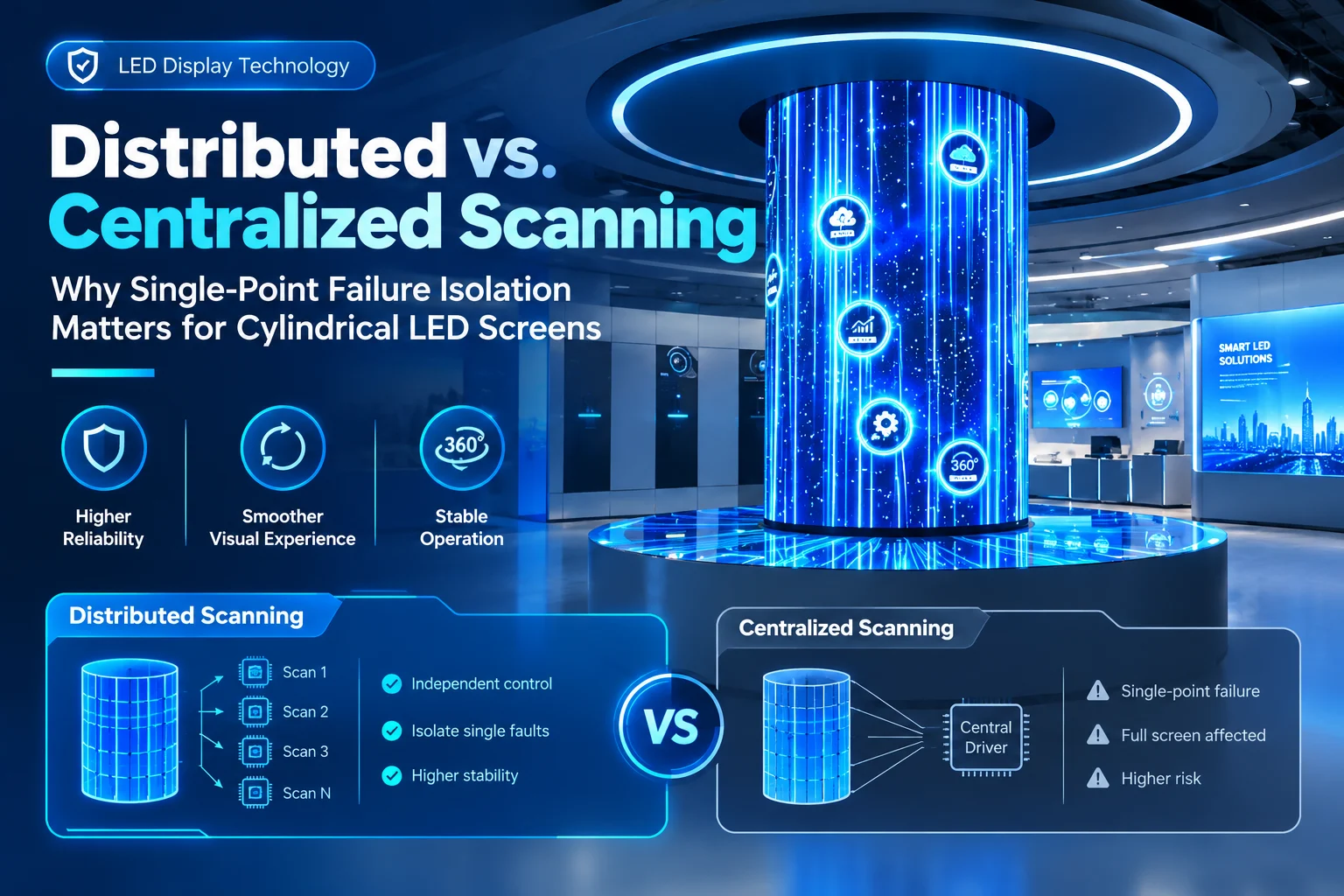
Distributed vs. Centralized Scanning: Why Single-Point Failure Isolation Matters for Cylindrical LED Screens
Cylindrical LED Screens: Distributed vs. Centralized Scanning
Cylindrical LED screens create 360-degree visual experiences in bars, luxury retail spaces, hotel lobbies, and exhibition booths. However, when a display module fails, the control architecture determines whether the fault affects one module or disrupts a larger section of the screen.
For commercial installations, even a small blackout can compromise visual continuity and interrupt customer experiences.
Understanding the differences between centralized and distributed scanning helps buyers evaluate cylindrical LED screens based on fault isolation, maintenance accessibility, system uptime, and long-term operating costs.
1. Centralized vs. Distributed Scanning for Cylindrical LED Screens
The scanning architecture determines how the display processes control signals and responds to component failures.
| System Parameter | Centralized Scanning | Distributed Scanning |
|---|---|---|
| Control Signal Processing | One centralized controller handles scanning and PWM data | Localized scanning cards and distributed driver ICs serve module groups |
| Failure Scope | A single fault may affect an entire column or downstream modules | Faults can be isolated to an individual module, depending on system design |
| Maintenance Method | May require extensive disassembly and power-down procedures | Supports front-service maintenance and, on compatible systems, hot-swapping |
| Operational Downtime | Potentially high, depending on fault location and access | Can be significantly reduced through modular replacement |
| Typical Applications | Fixed indoor displays with rear maintenance access | 360-degree cylindrical and curved displays in high-traffic venues |
The key difference is how each architecture handles faults. Centralized or cascaded signal paths can create larger failure zones, while distributed control can limit the impact of individual component failures.
However, actual fault isolation depends on the controller design, signal routing, power distribution, and redundancy measures—not simply whether a display uses distributed scanning.
2. Why Fault Isolation Matters for Cylindrical LED Screens
Unlike many flat displays installed against walls, cylindrical LED screens are often visible from multiple directions. A visible failure can therefore affect the entire installation’s appearance.
2.1 Preventing Cascading Signal Failures
In a centralized or daisy-chained signal topology, data passes through a sequence of connected modules.
For example:
Controller → Module 1 → Module 2 → Module 3
If a driver IC or signal connection fails, downstream modules may lose data when the architecture depends on that connection. The resulting blackout can extend beyond the original faulty component.
Distributed scanning separates control functions across local module groups. This can help contain a fault within the affected module while allowing other modules to continue displaying content.
For project buyers, the important questions include:
- Does a single driver IC failure affect only one module or multiple modules?
- Can downstream modules continue receiving valid signals after a fault?
- Does the controller support independent module addressing?
- Are backup signal paths or redundant connections available?
These questions reveal more about real-world reliability than the scanning architecture label alone.
2.2 Improving Maintenance Through Front-Serviceable Modules
High-traffic venues such as nightclubs, hotel lobbies, and trade show booths often have limited maintenance windows.
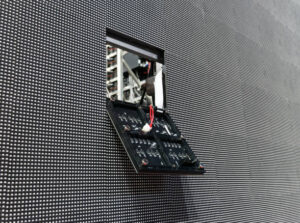
A cylindrical LED screen with magnetic front-service modules can make repairs easier when technicians cannot access the rear of the display.
Depending on the product design, front-service maintenance may offer three advantages:
- Direct module access: Technicians can remove a damaged module from the front using the specified service tool.
- Reduced repair time: Modular replacement can avoid dismantling larger sections of the cylindrical structure.
- Simplified calibration: Compatible control systems can apply stored calibration data to replacement modules to help restore color consistency.
Some systems support live module replacement, but buyers should verify whether hot-swapping is explicitly supported by the manufacturer. A magnetic attachment alone does not establish that a module can be safely removed while the display remains powered.
The original design target is to allow site personnel to replace a faulty module in under 3 minutes. Actual replacement time depends on module access, safety procedures, calibration, and operator training.
2.3 Managing Mechanical Stress in Flexible LED Modules
Cylindrical LED screens often use flexible modules that conform to curved surfaces. Repeated bending and installation stress can affect copper traces and electrical connections.
Distributed control layouts may reduce the number or density of high-speed signal traces crossing certain module boundaries, depending on the PCB design.
This can help engineers manage signal integrity and mechanical reliability. However, long-term performance also depends on bending radius, substrate material, copper layout, connector design, installation methods, and thermal conditions.
When sourcing flexible cylindrical LED displays, buyers should therefore assess both the control architecture and the mechanical design of the modules.
3. How Distributed Scanning Can Reduce Maintenance Costs
The initial hardware price is only one part of the total cost of ownership (TCO).
For commercial cylindrical LED installations, maintenance expenses can also include technician call-outs, replacement parts, troubleshooting, access equipment, and business disruption.
A distributed architecture may reduce these costs when it provides effective fault isolation and convenient module replacement.
| Cost Factor | Centralized Architecture | Distributed Architecture |
|---|---|---|
| Fault Diagnosis | A fault may require tracing a longer signal path | Localized control can help narrow the affected module group |
| Repair Scope | Some failures may require broader system inspection | Module-level replacement may limit the repair scope |
| Service Access | Rear access or structural disassembly may be necessary | Front access may simplify maintenance |
| Event Disruption | Depends on the extent of the blackout and repair time | Smaller failure zones can help preserve more of the display |
| Long-Term TCO | May increase when faults cause extensive downtime | May decrease when modular servicing reduces labor and disruption |
Although distributed scanning can require additional control hardware, its potential maintenance benefits may outweigh the initial cost in high-traffic commercial environments.
The best choice depends on the system’s actual failure behavior, serviceability, spare-module strategy, and expected operating schedule.
4. Frequently Asked Questions About Cylindrical LED Screens
Q1. Will one failed LED module turn off the entire cylindrical display?
Not necessarily. A distributed scanning architecture can isolate some module-level failures, allowing unaffected modules to continue displaying content.
However, a failed power supply, controller, shared signal connection, or other common component may affect a larger section of the screen. Buyers should request the manufacturer’s fault-isolation diagram and failure-response specifications.
Q2. Can technicians replace a damaged module without shutting down the display?
Some cylindrical LED screens support front-service replacement, and certain systems are designed for live hot-swapping.
However, hot-swapping depends on the module, power architecture, connectors, and manufacturer-approved service procedure. Buyers should confirm this capability before specifying uninterrupted replacement as a project requirement.
Q3. Does distributed scanning reduce long-term maintenance costs?
It can. Localized fault handling and modular replacement may reduce troubleshooting time, labor expenses, and display downtime.
The actual savings depend on the control architecture, spare-part availability, module replacement time, and consequences of operational interruptions.
Q4. What should buyers check before ordering a distributed scanning LED display?
Buyers should evaluate:
- Module-level fault isolation
- Signal-chain and backup-path design
- Front-service access
- Manufacturer-approved hot-swapping capability
- Module replacement and calibration procedures
- Spare-module availability
- Warranty and technical support
- Total cost of ownership
These specifications help buyers determine whether the display’s architecture meets the reliability requirements of the installation.
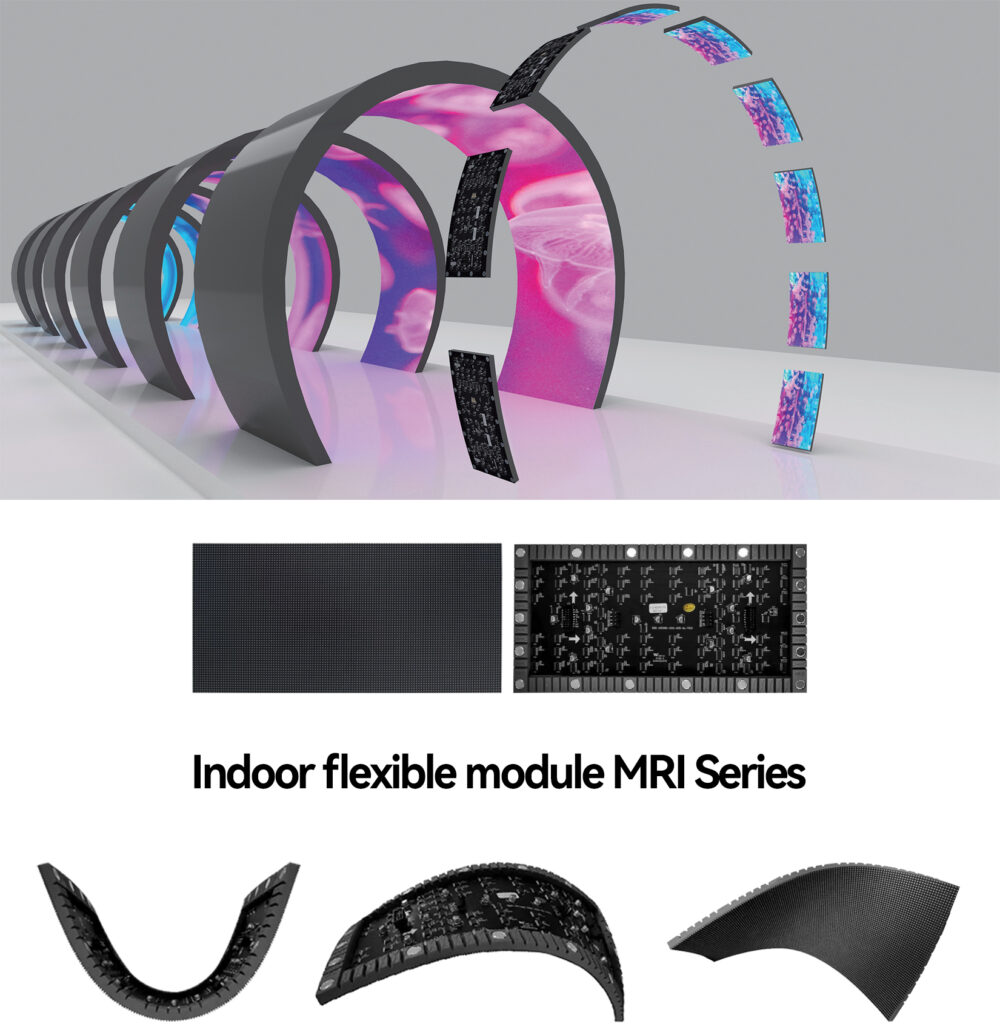
5. Procurement Checklist for Commercial Cylindrical LED Screens
Before selecting a cylindrical LED screen for a bar, hotel, retail space, or exhibition venue, buyers should request clear technical evidence.
| Evaluation Item | What to Verify |
|---|---|
| Scanning Architecture | Centralized or distributed control design |
| Fault Isolation | The expected impact of a failed driver IC or module |
| Signal Redundancy | Availability of backup signal paths |
| Module Access | Front-service or rear-service requirements |
| Hot-Swapping | Whether live replacement is officially supported |
| Calibration | Procedure for matching replacement modules to the display |
| Repair Time | Manufacturer-tested module replacement time |
| Flexible PCB Design | Supported bending radius and mechanical reliability |
| Spare Parts | Availability of compatible replacement modules |
| Lifecycle Cost | Hardware, maintenance, downtime, and support expenses |
This checklist helps project teams compare complete display systems rather than choosing based on scanning architecture alone.
Key Takeaways
- Fault isolation: Distributed scanning can limit certain failures to individual modules, reducing the risk of a cascading blackout.
- Front-service maintenance: Magnetic modules can simplify replacement when the display supports front access.
- Hot-swapping: Live replacement must be confirmed through the manufacturer’s specifications and approved procedures.
- Flexible module reliability: PCB layout, bending radius, and signal routing all affect long-term performance.
- Total cost of ownership: Reduced repair scope and downtime can offset higher initial hardware costs in demanding commercial environments.
Conclusion: Choosing a Reliable Cylindrical LED Screen Architecture
Selecting reliable cylindrical LED screens requires more than evaluating brightness, pixel pitch, and curved module design. Buyers should also understand how the scanning architecture handles failures and how quickly technicians can restore normal operation.
Distributed scanning can provide meaningful advantages when it supports localized fault isolation, modular servicing, and effective signal management. For high-traffic commercial venues, these capabilities can help preserve visual continuity and control long-term maintenance costs.
Before finalizing a project, request the manufacturer’s control architecture, fault-isolation specifications, module replacement procedures, and maintenance documentation. These details provide a stronger basis for evaluating reliability than architecture terminology alone.
About author

Leave a reply