
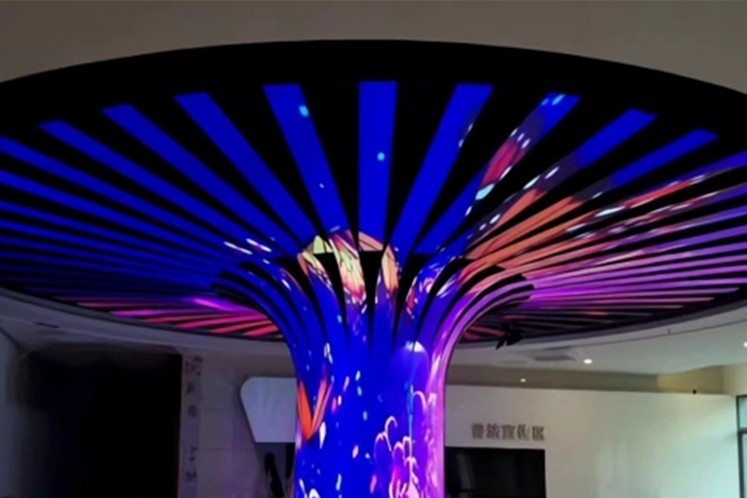
The Linear Poetry of Light: How Bar LED Displays Redefine “Line” and “Time” in Contemporary Art
Forget the flat screen—digital art is breaking free from the rectangle. Instead of chasing pixel density, artists now pursue visual essence. By removing complex imagery, technology returns to minimalist expression. Consequently, bar LED displays emerge as a new artistic medium.
When art meets the slim modular bar screen, information becomes emotion. Moreover, the display transforms into a precise brush of light. Through intentional alignment, artists draw lines made of photons. As a result, light simulates rain, flowing rivers, and passing time.
This article explores the fusion of aesthetics and engineering. Specifically, it reveals how pure lines reshape galleries and public spaces. Ultimately, bar LED displays turn environments into contemplative light experiences.
1. The Aesthetic of Reduction: Why “Lines” Matter in Digital Art
The history of art is built upon the line. From the charcoal strokes of cave paintings to the geometric abstractions of Mondrian, the line represents the boundary of space and the direction of movement. In our era of information overload, the bar LED display offers a welcome reduction—a return to a minimalist visual vocabulary.
Stripping the Clutter
Standard LED screens demand that the viewer look at an image. A bar LED display, however, invites the viewer to experience light. By isolating the light into a slender strip, the artist removes the distraction of narrative. We are no longer watching a movie; we are witnessing the raw behavior of light—its speed, its intensity, and its rhythmic decay.
The Simulation of Natural Phenomena
Lines are the DNA of nature’s movement.
-
Verticality: A series of vertically suspended bar LED displays can simulate the rhythmic descent of a summer rainstorm or the falling “data” of a digital waterfall.
-
Horizontality: Arranged horizontally, these screens can mimic the infinite horizon of the sea or the flickering trail of a shooting star.
-
The Aurora Effect: By pulsing colors through a staggered array of bars, artists can recreate the ethereal, wavering light of the Aurora Borealis within the confines of a concrete gallery.
2. Engineering the Slender Canvas: The Technology of the Bar Screen
To serve the high demands of contemporary art, a bar LED display must be more than just a strip of lights. It must be a precision-engineered module capable of sub-millisecond synchronization.
High-Resolution Linear Density
In a gallery setting, viewers are often close to the installation. Artists require a fine pixel pitch even on a narrow bar.
-
Micro-Pixel Integration: Modern bar screens achieve ultra-fine pitches (P1.5 to P2.5), ensuring that as light “travels” down the bar, the movement is fluid and continuous, without visible “jumping” between pixels.
-
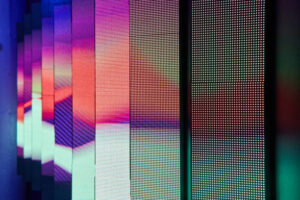
360-Degree Visibility: Many art-grade bar displays feature specialized casing that allows light to be visible from multiple angles, creating a three-dimensional “rod” of light rather than a flat, one-sided image.
The “Zero-Latency” Synchronization
When an installation consists of hundreds of individual bars, the “Poetry of Time” relies on perfect synchronization. If one bar is delayed by even a few milliseconds, the illusion of a flowing line is broken.
-
Distributed Control Architecture: Advanced modular systems use high-speed fiber-optic or Ethernet protocols to ensure that every bar in the array receives its data at the exact same moment, allowing a wave of light to sweep across a 50-meter hall with mathematical precision.
3. The Space Between: Using “Negative Space” as Art
One of the unique advantages of the bar LED display is that it allows the artist to “design with emptiness.” In a traditional screen, the background is always there. With bar screens, the space between the bars becomes part of the artwork.
-
Transparency and Depth: Because bar screens can be spaced apart, they allow the viewer to see through the installation. This creates a layered, holographic effect where the light seems to be floating in mid-air.
-
Interaction with Architecture: Artists can integrate these bars into the existing “bones” of a building—following the lines of a staircase, the curve of a ceiling, or the verticality of a pillar. The screen doesn’t sit on the wall; it becomes part of the wall’s pulse.
4. Writing “Time”: The Temporal Dimension of Linear Light
In contemporary art, time is often the fourth dimension. The bar LED displays are the perfect clock.
The Pulse and the Rhythm
By controlling the frequency of light pulses, artists can create a sense of “visual time.”
-
Slowing Down: A bar that slowly fills with light over ten minutes can represent the rising tide or the slow passage of a season.
-
Accelerating: High-speed flickers can mimic the frenetic pace of urban life or the firing of neurons in the brain.
The “Persistence of Vision”
Some artists use the movement of bar screens to create “persistence of vision” (POV) effects. By moving a single light bar rapidly through space while changing its display, the bar can “paint” a solid 3D image in the air. This explores the boundary between what is physically present and what is a temporal illusion.
5. Public Art and Cultural Landmarks: The Social Line
Beyond the gallery, the bar LED displays are transforming public infrastructure. From airport terminals to corporate atriums, these linear installations act as “social pacemakers.”
-
Wayfinding as Art: Instead of static arrows, a series of bar screens can “guide” a crowd with a flowing current of light, turning the act of walking through a terminal into a poetic experience.
-
Environmental Data Visualization: Some public art projects connect bar screens to real-time environmental data—such as wind speed or air quality—turning the “Line” into a living graph of the city’s health.
6. Conclusion: The Eternal Return to the Line
As we move deeper into the digital age, the bar LED display reminds us that complexity is not the same as depth. By focusing on the purest form of the “Line,” these screens allow us to write a new kind of poetry—one written in light and measured in time.
In the intersection of technology and art, the bar screen is the bridge. It takes the cold, binary reality of the LED and turns it into a warm, organic experience. Whether it is a single bar glowing in a dark room or a massive forest of light in a public plaza, these linear guardians prove that sometimes, the simplest line can tell the most profound story.
About author

Leave a reply